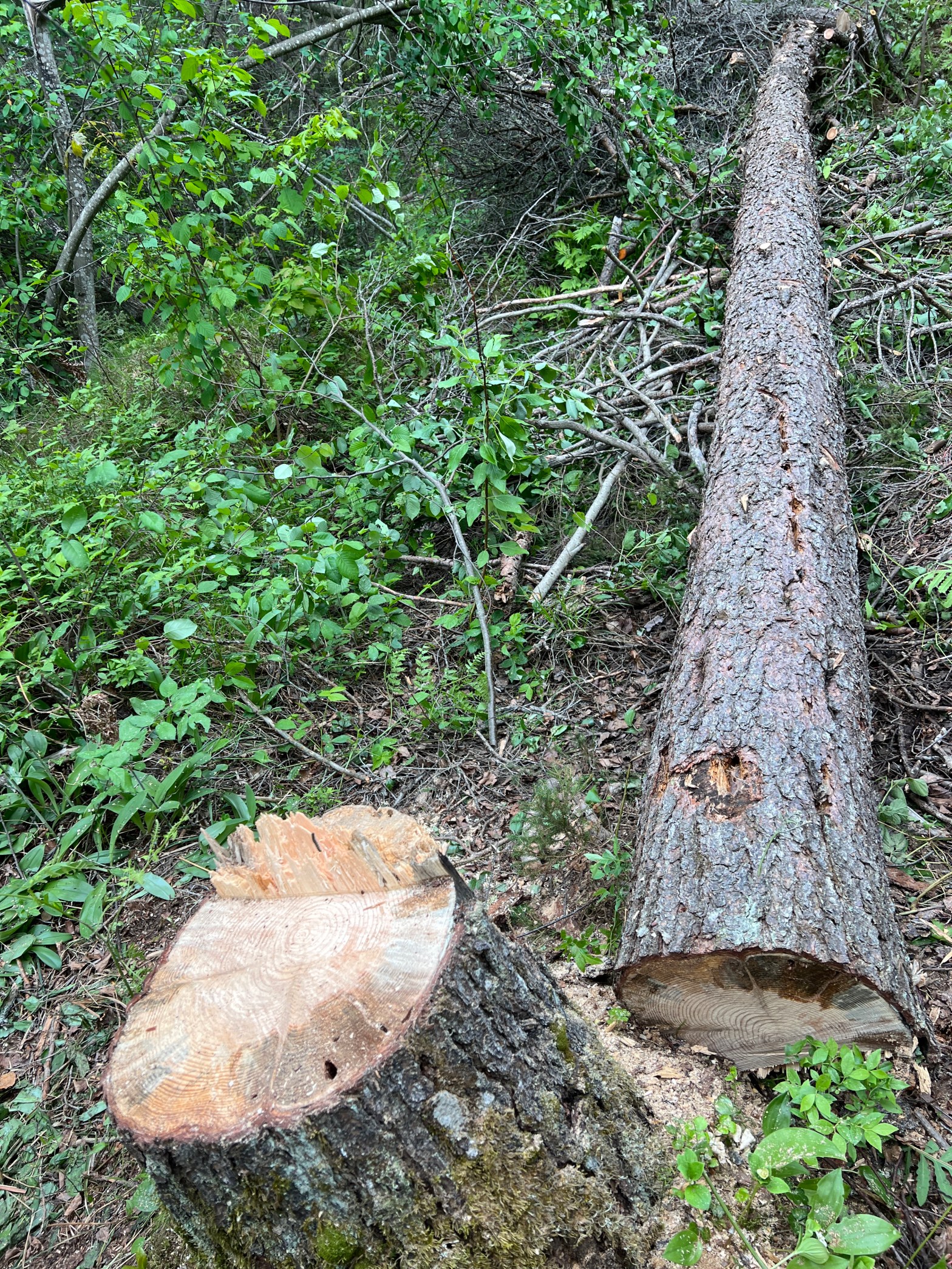
I did not ever imagine that I would put a chainsaw on my Christmas wish list, but last year, I did: a 16” Ego electric saw. I had volunteered to be the steward of several local nature preserves, and part of my duties included trail maintenance. I could either do the maintenance myself, or report to the land conservancy where maintenance was needed. My husband was game to come with me with his saw and cut down what needed removing, but I wanted to learn how to do it myself, without needing to borrow his saw.
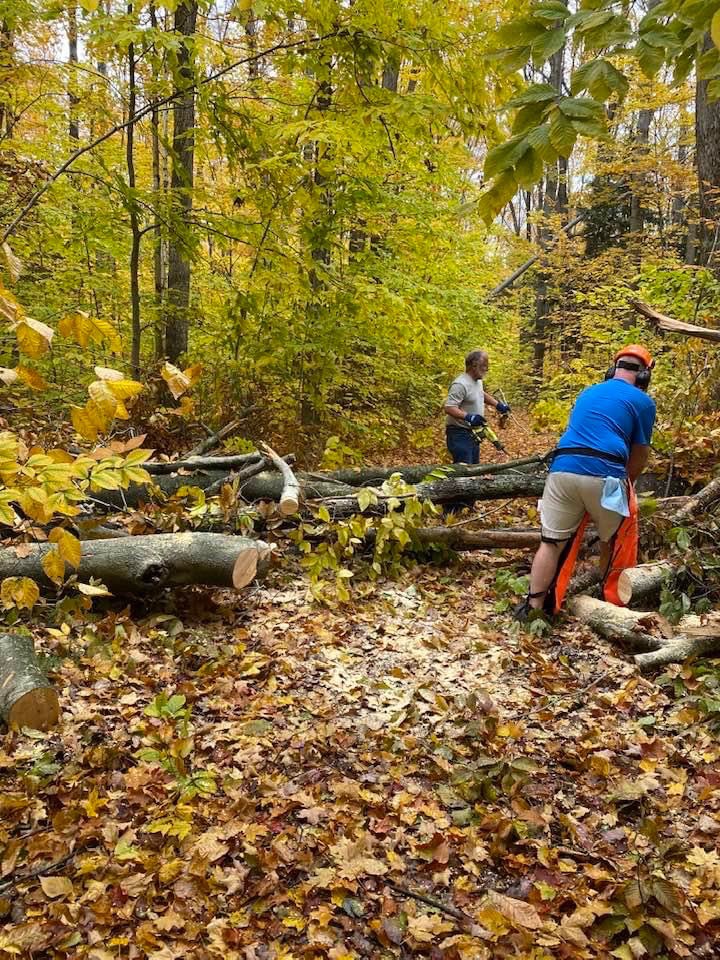
After Christmas, my husband Geoff was a huge help, not only gifting me a saw, but showing me how to safely remove downed trees, first in the woods by our house, and later in the preserves. This met the safety requirements of the land conservancy, as he accompanied me on every trip. However, the North Country Trail (NCT) requires certification through the National Parks Service (NPS), and after coming along on a maintenance hike with a local sawyer, I decided to pursue the sawyer certification so that I could volunteer to work on sections of the NCT, too. My local NCT chapter newsletter had mentioned that a few people were signed up for this training, and I responded to the newsletter to find out how I could sign up, too.

In order to participate in the sawyer training, I completed an online video series by the NPS called “Trail Safe.” I was surprised to find that it didn’t specifically deal with cutting trees so much as evaluating the risk in various situations one might encounter on trail (weather hazards, river crossings, etc.) that relate to hiking and backpacking, as well as being a sawyer. The Trail Safe videos were exceptional in their relevance and clarity. I feel that everyone who spends time in the backcountry could benefit from watching them. Participants also had to be certified in First Aid and CPR by the Red Cross, which I already had since I work as a lifeguard at our local pool.
I was accepted into a training program in Marquette, Michigan on June 10-12, which followed a backpacking trip I’d be taking to the Upper Peninsula June 1-7 in that vicinity, allowing for a couple of days to recover and get cleaned up before the training began. As it turned out, the bugs were so bad on the backpacking trip that we hiked our asses off each day and finished early, so I had a little break in between to come home, get my gear put away, and sleep in my own bed, which was lovely.
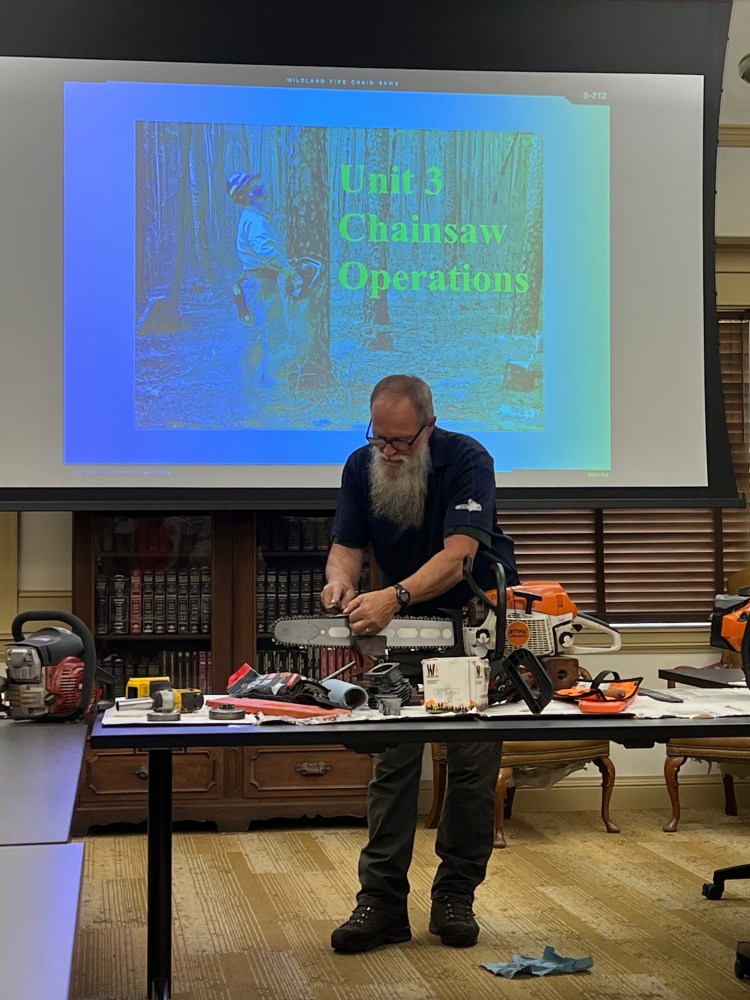
Then it was back up north for sawyer training. The first day was a classroom day. We met at the Peter White Library in Marquette, and from 8:00 a.m. to 4:00 p.m. learned the various parts of a chainsaw, how to adjust tension on the chain, how to sharpen the chain, and various other maintenance information. Then we moved onto cutting techniques, watching videos and looking at diagrams regarding how to size up a tree and how to take it down and control where it fell. We learned various techniques for cutting the wedge that would determine in what direction the tree would fall, and how to do the back cut so that a hinge of wood could control the tree’s fall as the sawyer left the area for safety. We learned techniques for bucking up fallen trees, and strategies to avoid getting the saw bar pinched in the kerf (the cut) as the pressure changed within the tree trunk.
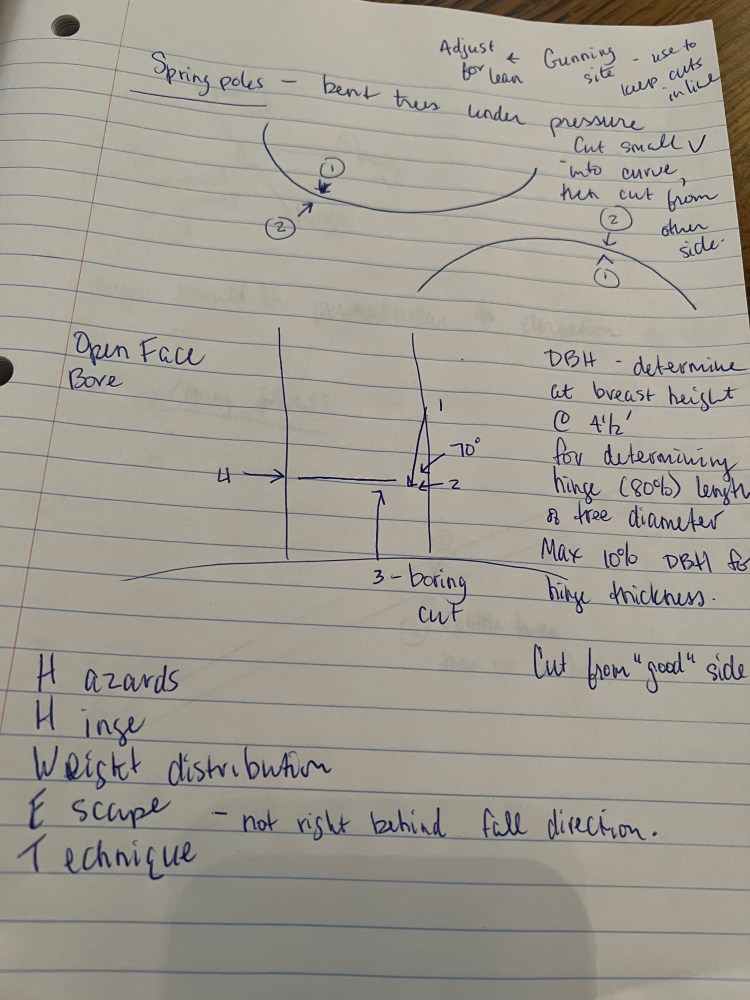
Safety was a huge part of the training. The NPS provided chaps, work gloves, hard hats and ear protection, and safety glasses free of charge to anyone attending the training, although I think most of us already had this gear. We learned about the most commonly injured areas when using a chainsaw (damage to thighs, lower legs, and forearm, and kickbacks hitting the shoulder, face and neck) and how to consider our own limitations, such as fatigue or lack of knowledge in approaching a complicated situation, such as a blowdown of many trees where it might be difficult to identify where the binds and pivot points might be. We also learned about keeping others safe, as there might be hikers or other workers in the area. By the end of the day, I felt like my head might explode, there was so much new information. My notebook was full of diagrams regarding hinges, and the formula for deciding how deep into the tree trunk they should be, and how to approach spring-poled trees, and trees suspended in different ways.
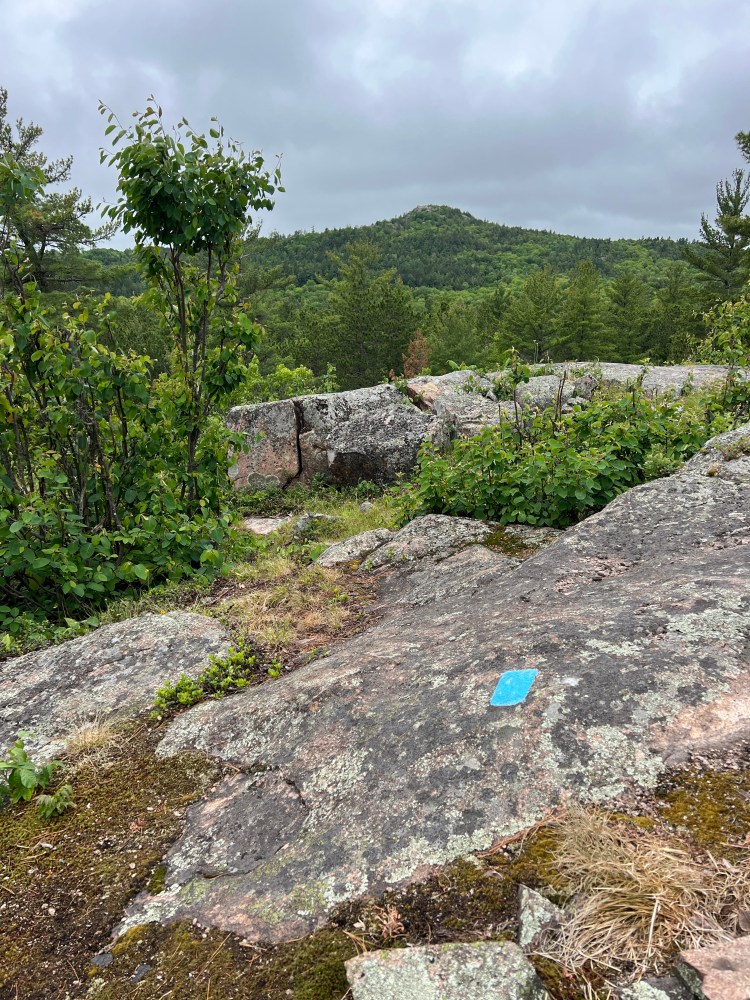
The following day, Sunday, half of our class of 20 went to a local park to practice cutting with Scott, our instructor, and the rest of us had to wait a day, so I took advantage of the day off to hike out at Wetmore Landing, going to Hogback Mountain and back, and doing some other short trails along Lake Superior, then spent the evening watching Park Service videos to review for my cutting session the next day.
The forecast for Monday was 80% chance of rain all day. The prospect of cutting in the wet woods all day was not awesome, but I’m a hiker, so I have the gear to make it as comfortable as possible. I packed up from my Airbnb with multiple layers of breathable clothing, and a rain jacket, and left for Little Trout Lake park near the old KI Sawyer Air Force Base. It was 37-degrees, but dry.
When I arrived at the park I chatted with other classmates. One man worked for the city of Marquette, and was attending the training for his job, and most of the others had been volunteering on the NCT for ages, and had completed this course many times. (The certification is good for three years.) They explained what would happen during the course of the day, and were very encouraging.
When our instructor, Scott, arrived, he had us drive further into the park along a closed road. The park looked pretty neglected. It had been a campground, and was on a nice little lake, but I’m guessing that when the air force base closed, it fell into disuse. We stopped along the road, just past a sketchy bridge that had a beaver dam built up on one side. Now I knew why the road was closed!
Scott showed us the work that the previous day’s group had done–bore cut practice in a downed tree trunk, trees they had bucked up, stumps with evidence of hinges that controlled the fall of the trees. We practiced bore cutting for a while in some of the downed tree trunks until all of us had brick-shaped souvenirs from the trees, then Scott had us begin to look for dead trees to take down.
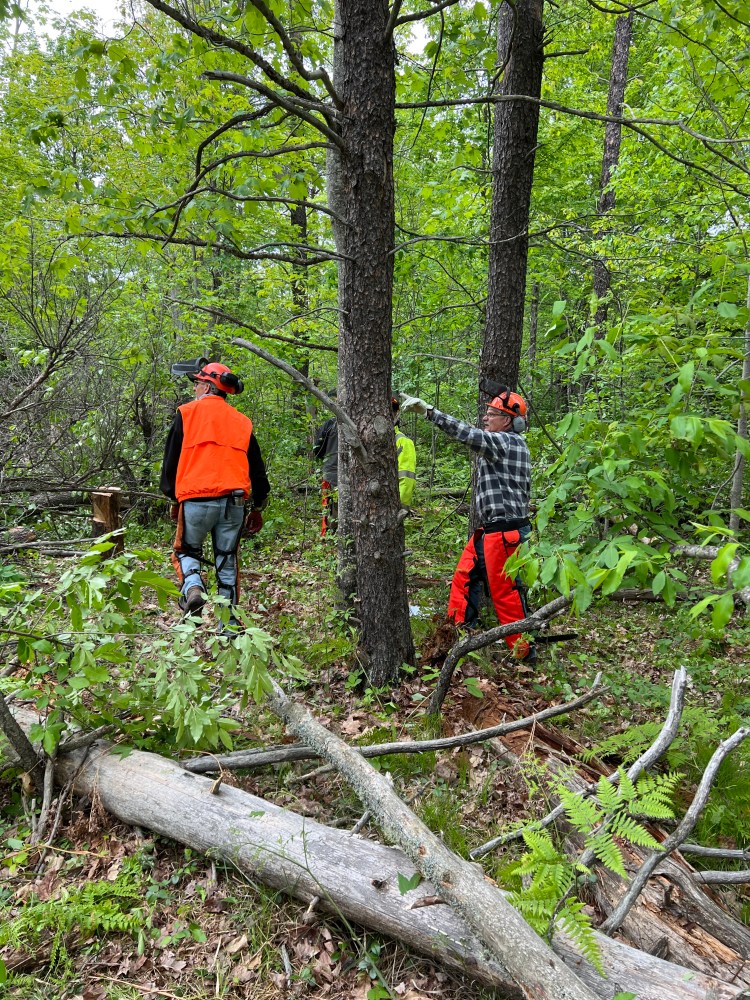
Each person would need to identify a tree, size it up, establish where the tree was going to fall, clear two escape routes, create a cut plan, keep the rest of the group safe, and execute the cut plan. Afterward, the group would discuss what went well, and what could have been done better. The man who worked for the city volunteered to go first, and it was obvious that he knew what he was doing. His tree fell exactly where he said it would, and his hinge was at a perfect 80% of the tree’s diameter. We watched him carry out his cuts from a safe distance, and then moved in to discuss around the stump after the tree was safely down.
I had never cut down a tree before, only bucked up trees that had fallen of their own accord, and removed leaning trees that were blocking the trail, so I was pretty intimidated. I wondered how small of a tree I could choose for my own demo! Another person in the group volunteered to go next, and we went through the same process. This man was a long time volunteer, maintaining the NCT near Grand Marais, and said he had already cut over 100 trees this year. (I recently hiked this area, and I knew there were tons of blow downs, so I could understand why he had gotten so much practice!) I expected that his cut would go just as smoothly as the first person, but his dead tree got hung up on another tree, broke off midway down, leaving the dead tree top as a widow-maker in another tree, and the trunk hung up on a branch further down that same tree. Scott walked him through how to get the tree down, using cuts to the bottom of the trunk. It took quite a while to get the tree safely to the ground. One of the other newbies in the group said to me, “I”m not quite so nervous about doing my own now,” and I laughed, feeling the same way. Even though this tree hadn’t gone exactly as planned, it was a good learning experience, and the instructor, Scott, treated it as such.
I practiced my open-face cut and back cut on a couple of stumps, and asked Scott for feedback before felling my own tree. Once I chose my victim, I cleared brush and cut up the dead trees on the ground near it in order to create an escape path, and identified a direction with no obstacles for the tree to fall–a direction it was leaning already. I directed everyone else to clear the area, and loudly announced what I was doing at each step. I made my open-face cut to create a wedge in the direction I wanted the tree to fall. Then I made my back cut from the opposite direction, stopping just shy of the back of my wedge, to leave a hinge. However, the tree didn’t move, so I had to make the back cut a little deeper, but still leave a hinge. Finally, I could feel the tree shift, and I pulled out the saw and used my escape path to walk away as the tree fell, landing exactly where I wanted it to! I was so relieved! Scott examined my stump, especially my hinge, measured where the tree had fallen in comparison to my goal location, and wrote up my evaluation as he talked me through it, watching as I removed branches from the fallen tree and bucked it up.
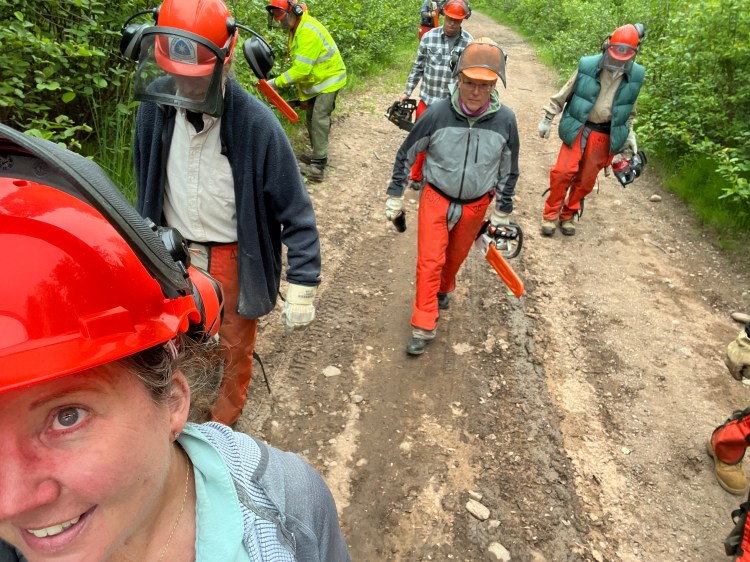
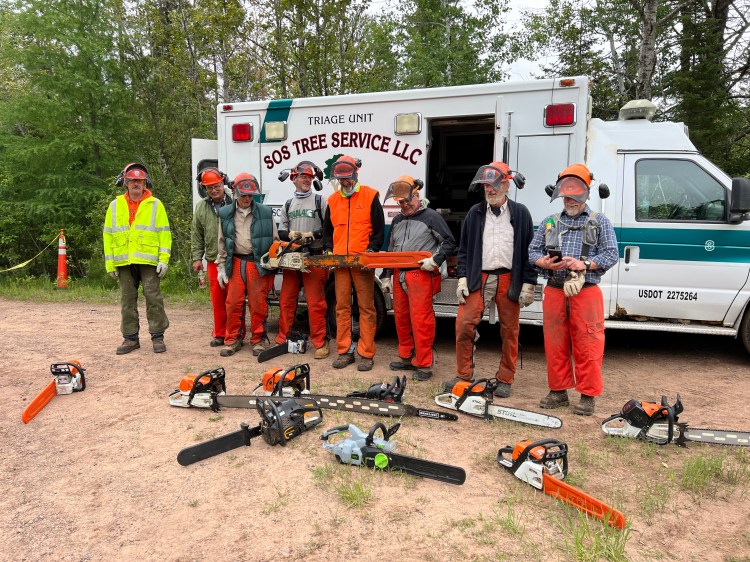
In the next couple of hours, the rest of the group completed their tree felling evaluations, and we gathered together at Scott’s truck, an old ambulance that he had retrofitted for his tree service. We took a group picture and then parted ways. As I got into my car to begin the drive back to Charlevoix, a three and a half hour drive away, the predicted rain finally began. I was tired and happy at the completion of this challenge.
 Exploring Michigan and other cool places